
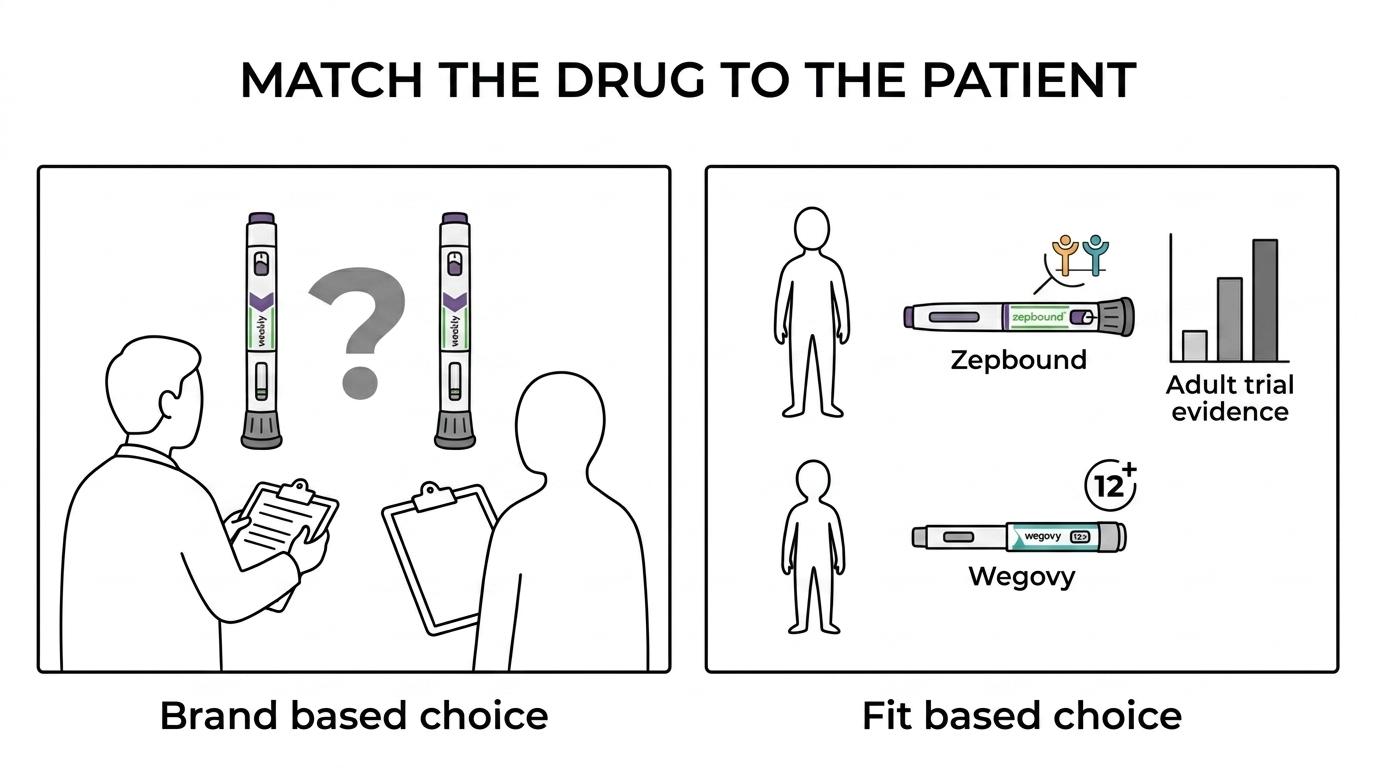
Choosing between Wegovy and Zepbound is less about brand names and more about matching the right drug, trial data, and FDA approval to the right patient. The biggest differences are the active ingredient, receptor targets, age eligibility, dose options, and the type of weight-loss data each drug brings to the table.
Summary
- Zepbound and Wegovy are not the same weight-loss medication: Zepbound contains tirzepatide and is FDA-approved for chronic weight management in adults, while Wegovy contains semaglutide and has FDA-supported use that includes pediatric obesity data plus a newer higher-dose adult option.
- Zepbound generally shows a stronger average weight-loss signal in its adult obesity trials, with the FDA reporting about 18% average body-weight reduction at the 15 mg dose after 72 weeks versus placebo.
- Wegovy has broader age-related labeling relevance because its label includes a 68-week randomized pediatric obesity trial in 201 pubertal patients age 12 and older.
- Mechanistically, Wegovy is a GLP-1 receptor agonist, while Zepbound is both a GLP-1 receptor agonist and a glucose-dependent insulinotropic polypeptide receptor agonist.
- Both drugs are once-weekly injections used with a reduced-calorie diet and increased physical activity, but cross-trial comparisons are imperfect because the studies differed in duration, population, and design.
- If the patient is an adult focused on the strongest average weight-loss data, Zepbound often becomes the main comparison point; if age eligibility, semaglutide familiarity, or pediatric obesity treatment matters, Wegovy may fit better.
The right choice still depends on age, medical history, side-effect tolerance, access, and whether the goal is adult obesity treatment only or a broader FDA-labeled pathway. A careful comparison saves time because the "best" option on paper is not always the one a patient can tolerate, obtain, or stay on long enough to matter.
Is Zepbound or Wegovy better for weight loss?
Zepbound usually shows the larger average weight-loss signal in available adult obesity trials, while Wegovy has broader age-related approval data. The FDA summary for Zepbound reports about 18% average body-weight reduction at 15 mg after 72 weeks versus placebo, but that is not a direct head-to-head trial against Wegovy.
That distinction matters. Patients often compare percentages from separate studies as if they came from the same trial, but cross-trial comparisons can mislead because inclusion criteria, diabetes status, baseline BMI, and study duration were not identical.
If the question is pure average weight-loss potential in adults, Zepbound often comes out ahead in discussion. If the question is broader FDA-labeled flexibility, especially around adolescent obesity data and semaglutide-based treatment, Wegovy holds advantages that are easy to miss.
James Whynot MD provides physician-guided medical weight loss through secure audio/video visits, with same-week appointments available for adults in FL, ME, MA, PA, and SC.
A practical way to think about it is this: stronger average efficacy data can matter, but only if the patient can access the drug, tolerate dose escalation, and stay engaged with follow-up.
Are Wegovy and Zepbound the same kind of medication?
No. Wegovy is semaglutide, while Zepbound is tirzepatide, and the receptor biology is different.
Wegovy is FDA-classified as a GLP-1 receptor agonist. Zepbound is FDA-classified as both a GLP-1 receptor agonist and a glucose-dependent insulinotropic polypeptide receptor agonist. In plain language, both affect appetite and metabolic signaling, but tirzepatide acts on two incretin pathways rather than one.
A common misconception is that patients should treat them as interchangeable "GLP-1 shots." That shorthand is useful in casual conversation, yet it leaves out a real difference in mechanism. If a patient had poor tolerance or weak response with one class member, the next step is not automatic, but the receptor distinction may still shape the discussion.
The related terms matter because they help explain why dosing, side effects, and expected response may not feel identical even when both drugs are taken once weekly.
What are the 7 most important differences between Wegovy and Zepbound?
The clearest answer is that seven differences drive most patient decisions: molecule, mechanism, who can take it, dose pathway, trial design, trial duration, and how weight-loss results should be interpreted.
- Active ingredient: Wegovy contains semaglutide. Zepbound contains tirzepatide.
- Receptor activity: Wegovy is a GLP-1 receptor agonist. Zepbound acts on GLP-1 and glucose-dependent insulinotropic polypeptide receptors.
- Age eligibility: Zepbound's weight-management approval is for adults. Wegovy also has pediatric obesity data in adolescents age 12 and older.
- Dose landscape: Both are weekly injections, but Wegovy now also has an FDA-approved higher-dose 7.2 mg option for certain adults, while Zepbound's approved adult weight-management dosing reaches 15 mg.
- Trial duration: Zepbound's pivotal adult obesity data emphasized a 72-week trial. Wegovy's pediatric obesity label includes a 68-week trial.
- Trial population: A major Zepbound obesity trial enrolled 2,539 adults age 18 and older with obesity or overweight plus at least one weight-related comorbidity. Wegovy's pediatric trial enrolled 201 pubertal patients age 12 and older with obesity.
- Weight-loss signal: Zepbound's FDA summary reports statistically significant weight reduction at all three studied dose levels versus placebo, with about 18% average body-weight reduction at 15 mg after 72 weeks. Wegovy's value in this comparison is less about beating that number and more about broader labeled use and semaglutide-specific pathways.
The quiet lesson is that "better" depends on which difference matters most in the real clinical scenario.
How should you choose between Wegovy and Zepbound step by step?
Start with patient fit, not online hype. A good choice usually becomes clearer after three steps: confirm eligibility, match the drug to the clinical goal, then test whether access and tolerability are realistic.
First, confirm the FDA-labeled lane. If the patient is an adult with obesity or overweight plus a weight-related condition, both drugs may enter the discussion. If the patient is an adolescent, Wegovy's pediatric obesity data changes the conversation right away.
Next, match the medication to the main objective. If the goal is the strongest average adult weight-loss signal from currently available pivotal data, Zepbound often gets serious attention. If semaglutide familiarity, adolescent labeling relevance, or a Wegovy-specific dose strategy matters more, Wegovy may make better sense.
Then check real-world feasibility. If insurance excludes one drug, if side effects block titration, or if follow-up cannot happen reliably, the "best" theoretical choice may not be the best practical choice.
James Whynot MD uses lab-informed treatment plans and can order Quest Diagnostics testing as part of telehealth weight management.
One more point often gets overlooked: higher efficacy on paper does not erase the need for sustained nutrition, activity, and follow-up. These drugs work best as part of a long-range plan, not as isolated prescriptions.
Who is eligible for Wegovy vs Zepbound under FDA approval?
Zepbound is approved for adults, while Wegovy has adult use plus pediatric obesity data and labeling relevance for patients age 12 and older.
The FDA approved Zepbound on November 8, 2023 for chronic weight management in adults with obesity or overweight and at least one weight-related condition, to be used with a reduced-calorie diet and increased physical activity. That "adults" limit is one of the cleanest differences between the two products.
Wegovy, by contrast, has a pediatric obesity trial in its label: a 68-week, randomized, placebo-controlled, multicenter study in 201 pubertal patients age 12 and older with obesity. That does not make Wegovy the right choice for every teen, but it does mean the evidence base covers a younger group that Zepbound's weight-management approval does not.
A common mistake is to treat "not FDA-approved for this age" as proof that a drug can never be considered in any broader clinical context. Approval status is a regulatory boundary first. It should still guide routine prescribing decisions very strongly.
How do Wegovy and Zepbound dosing and dose escalation compare?
Both Wegovy and Zepbound are once-weekly injections, but their dose pathways are not interchangeable. Zepbound titrates tirzepatide through its own dose ladder, while Wegovy follows semaglutide titration and now includes a 7.2 mg higher-dose adult option.
Dose escalation exists for a reason: it helps patients adapt, especially to nausea, early fullness, reflux, constipation, or loose stools. If one step is too fast, adherence usually suffers before efficacy has a fair chance to show up.
A useful misconception check: a bigger milligram number does not mean a stronger drug across different molecules. That same caution applies when comparing tirzepatide and semaglutide — dose numbers only make sense when the molecule, receptor profile, and study context are kept separate.
- Frequency: Both are taken once weekly by subcutaneous injection.
- Escalation style: Zepbound uses tirzepatide dose increases up to 15 mg; Wegovy uses semaglutide escalation and now includes a 7.2 mg FDA-approved option for certain adults.
- Clinical meaning: Tolerability during titration often matters as much as the target dose.
- Common error: Comparing the numbers alone can lead to the wrong expectation about potency.
If nausea or appetite suppression becomes too intense, the next step is usually not to quit silently. It is to review timing, meal pattern, hydration, and whether the dose increase was simply too aggressive for that patient.
What do the 68-week and 72-week trials actually tell patients?
The trials tell patients that both drugs work, but they answer different questions in different populations. Zepbound's 72-week adult obesity data and Wegovy's 68-week pediatric obesity data should not be read as the same evidence type.
According to the Zepbound label, one weight-reduction trial enrolled 2,539 adults age 18 and older with obesity or overweight plus at least one weight-related comorbidity and ran for 72 weeks. The label also states that body-weight reduction was observed irrespective of age, sex, race, ethnicity, baseline BMI, and glycemic status.
Wegovy's label includes a 68-week pediatric trial in 201 pubertal patients age 12 and older with obesity, using a randomized, placebo-controlled, multicenter design. That is highly relevant if the patient or family is weighing options for adolescent treatment.
The key trade-off is evidence breadth versus adult efficacy signal. Zepbound's adult data are compelling, while Wegovy's dataset is more helpful when age range and semaglutide-specific labeling matter.
How can you check insurance coverage and medication access step by step?
Coverage for Wegovy or Zepbound is usually a documentation problem before it is a medical problem. The fastest path is to verify indication, gather chart evidence, and submit what the plan actually asks for.
Start by confirming the insurer's obesity-drug policy. Many plans require BMI thresholds, a qualifying comorbidity, and proof that the medication will be used with diet and activity changes. If the policy lists preferred products, that can shape the first prescription choice.
Next, gather the details that prior authorization teams look for: current weight, BMI, relevant diagnoses, prior weight-loss efforts, medication history, and reasons one option may fit better than another. If the chart is vague, denials become much more likely.
James Whynot MD offers insurance and manufacturer assistance for medication access as part of concierge telehealth weight-loss care.
Then prepare for the second layer. If the first request is denied, an appeal may need medical necessity language, documentation of intolerance or contraindication, or a switch to the covered alternative. This is where many patients lose momentum, even when the treatment itself is appropriate.
- Verify: Check plan formulary status and prior authorization criteria.
- Document: Record BMI, comorbidities, prior therapies, and treatment goals.
- Support: Use lab data, visit notes, and follow-up plans to strengthen the request.
What should you monitor during the first 8 to 12 weeks on treatment?
Early monitoring should focus on tolerability, hydration, nutrition intake, and whether the patient can stay on the plan long enough to benefit. Weight matters, but it is not the only useful signal in the first 8 to 12 weeks.
First, track side effects in a concrete way. Note nausea, vomiting, reflux, constipation, diarrhea, food aversion, dizziness, and fluid intake. If symptoms cluster right after dose escalation, that pattern often points to timing or dose tolerance